Arriving for your first dental appointment in a new country is understandably nerve-wracking — you want to know exactly what happens, who you will talk to, and what it will cost before you commit. The good news is that a first visit at a reputable Hanoi clinic is calm, structured and transparent. This guide walks you through each step so you know precisely what to expect.
Step 1: The Consultation
Your first appointment begins with a consultation. An English-speaking dentist examines your teeth and gums, asks about your dental history and discusses what you want to achieve — whether that is replacing a missing tooth, improving your smile, or simply getting a check-up and clean.
At top-rated clinics such as Picasso Dental (Old Quarter and West Lake) and Westcoast International Dental, this conversation is unhurried. Bring any relevant records, recent X-rays or photos if you have them. If you booked through a platform like SmileJet, the clinic may already have notes from your enquiry, which speeds things up.
Most consultations are free or low-cost, and there is no obligation to proceed with treatment on the day.
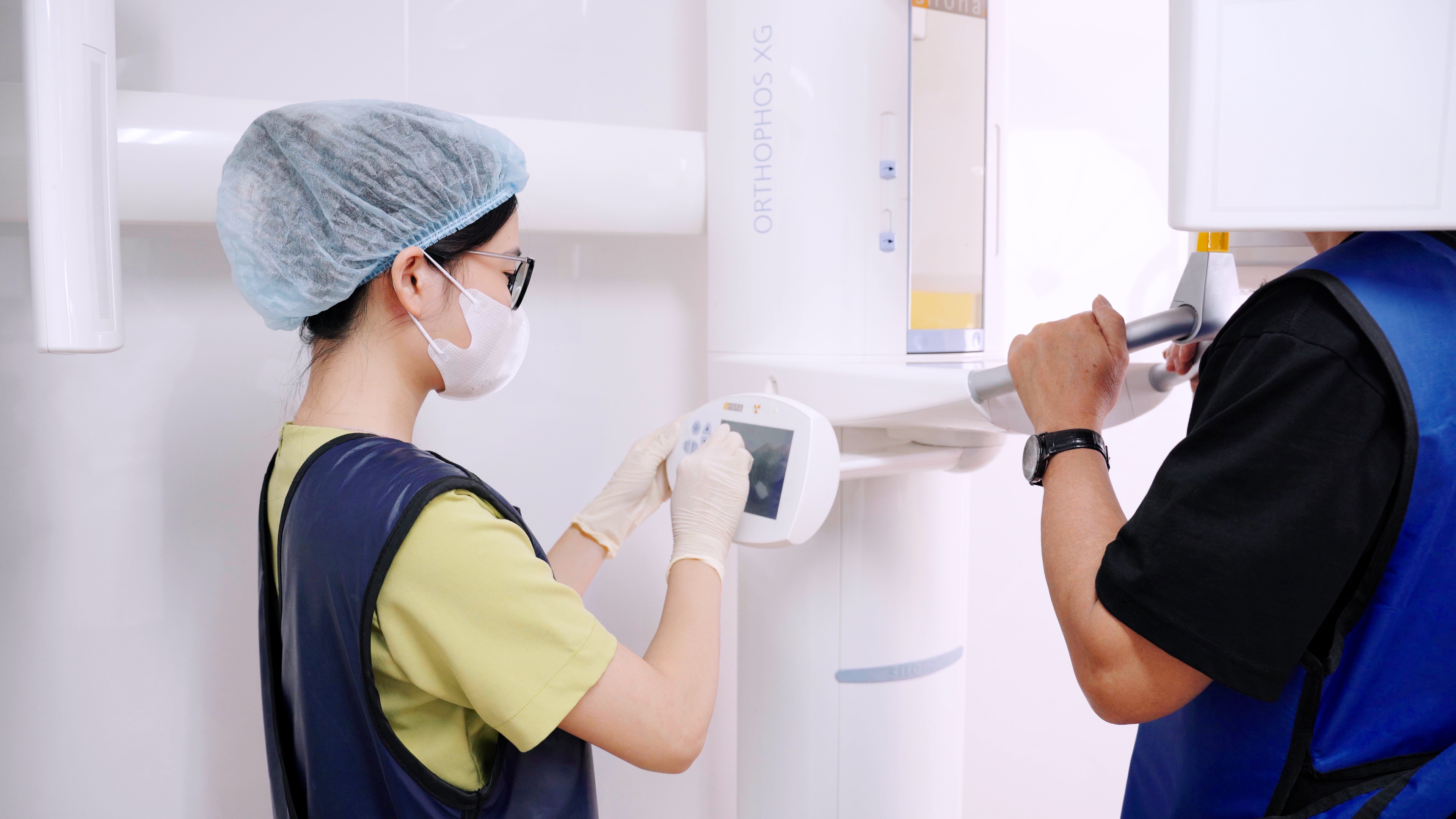
Step 2: X-ray and CBCT Imaging
To diagnose accurately, the dentist usually takes diagnostic images. There are two common types:
- Panoramic X-ray — a single wide image showing all your teeth, jaw and surrounding bone. Useful for general check-ups, extractions and root canals.
- CBCT (cone beam CT) scan — a 3D scan that shows bone volume and nerve position in detail. This is essential for planning dental implants and All-on-4 treatment.
Top Hanoi clinics use modern digital imaging, so radiation exposure is low and results appear on screen within minutes. Imaging may carry a small separate fee; the clinic confirms this before scanning, so there are no surprises.
Step 3: Your Treatment Plan
Once the dentist has reviewed your images, you receive a treatment plan. A good plan is specific: it lists each procedure, the materials or implant brands proposed, how many appointments are needed, and the expected timeline.
This matters for dental tourists, because the plan tells you whether the work fits your trip. For example, implants typically need a healing period between placement and the final crown, while crowns and veneers can often be completed within one to two weeks. Ask questions freely — a reputable dentist welcomes them.
Step 4: The Written Quote
Alongside the plan, you receive a written, itemised quote. This is one of the biggest reassurances of treating in Hanoi: you see the full cost before agreeing to anything. Below are typical Hanoi price ranges for 2026.
| Treatment | Hanoi price (USD) | Notes |
|---|---|---|
| Consultation | Often free | Imaging may be a small extra fee |
| Cleaning | From $20 | Scale and polish |
| Root canal | $70-200 | Per tooth, varies by complexity |
| Crown (zirconia/PFM) | $80-350 | Material affects price |
| Veneer | From $150/tooth | Porcelain or composite |
| Single implant | $500-1,500 | Osstem $500-900; Nobel Biocare $900-1,400; Straumann $1,000-1,500 |
| All-on-4 | $4,500-9,000/arch | Full-arch restoration |
These prices are roughly 60-85% lower than equivalent treatment in the US, UK or Australia. For context on quality, the global dental implant failure rate is under 3%, and leading Hanoi clinics report 95-98% success.
If a quote feels unclear, ask the coordinator to explain each line. You are entitled to take the plan away, compare it against another clinic, or seek a second opinion — there is no pressure to decide on the spot.
Step 5: Language and Payment
Language
Communication is rarely a barrier at the main international clinics. Picasso Dental, Australian Dental Clinic, Westcoast International Dental, Minh Thu Dental and Greenfield Dental all work with international patients, and Westcoast is multilingual. For anything important, ask for it in writing so nothing is lost in translation.
Payment
Most established clinics accept cash (VND or USD), bank transfer and major credit cards, though cards may add a small processing fee. The exchange rate sits at roughly 25,500 VND per USD. For larger treatments such as implants or All-on-4, payment is commonly split into stages aligned with your appointments. Confirm accepted methods and any fees when you receive your quote.
A Few Practical Tips
- Book ahead. Reserving your first appointment before you fly keeps your schedule tight and predictable.
- Use Grab for transport between your hotel and the clinic — it is cheap, metered and easy.
- Don’t drink tap water in Hanoi; stick to bottled or filtered water, especially after procedures.
- Keep your documents. Save your treatment plan, quote and any imaging files in case you need follow-up care at home.
A first visit in Hanoi is designed to inform, not to commit you. You leave with a clear diagnosis, a written plan, a fixed price and time to think — exactly what you would hope for anywhere in the world, at a fraction of the cost.
Related Reading
- Dental Implants in Hanoi
- Hanoi Dental Prices 2026
- Is Dental Work in Vietnam Safe?
- Picasso Dental, Old Quarter
- How Long to Stay for Dental Implants
Sources
- International Team for Implantology (ITI) — clinical guidelines on implant treatment planning and CBCT use, 2025.
- American Dental Association — patient guidance on dental examinations and treatment plans, 2025.
- Australian Dental Association — national dental fee survey data, 2025.
- World Health Organization — oral health and patient safety reference materials, 2025.