Vietnam has become one of Southeast Asia’s most popular retirement destinations for English-speaking expats, and Hanoi in particular has a growing long-term expat community drawn by low cost of living, rich culture, excellent food, and a genuinely warm reception for foreign residents. For retirees settling in Vietnam, dental care is one of the most frequent practical questions — particularly for those who need ongoing restorative work and want to build a long-term relationship with a clinic rather than making periodic dental tourism trips.
This guide covers what expat retirees in Hanoi need to know about long-term dental care: what it costs, how to choose the right clinic for a resident relationship, how dental records and continuity work, and how to think about insurance when dental bills are a fraction of what you paid at home.
Why Dental Care Is a Retirement Advantage in Vietnam
For most Western retirees, dental care was their single largest uninsured healthcare expense. Out-of-pocket crown replacements, implants to replace failing teeth, and the ongoing cost of preventive care add up quickly in Australia, the UK, Canada, and the United States — often several thousand dollars per year for anyone with ageing dentition.
In Vietnam, that calculation reverses. The same international-standard care, delivered with modern equipment by trained clinicians, costs a fraction of the Western equivalent:
| Treatment | Hanoi (International Clinic) | Australia / UK / USA | Approximate Saving |
|---|---|---|---|
| Clean, scale & check-up | $15–$30 | $120–$250 | 75–88% |
| Tooth-coloured filling | $30–$80 | $150–$350 | 70–80% |
| Porcelain crown | $120–$280 | $1,000–$2,500 | 75–88% |
| Single dental implant (complete) | $500–$1,500 | $3,000–$7,000 | 75–85% |
| All-on-4 full arch | $5,000–$9,000 | $20,000–$35,000 | 70–80% |
| Invisalign (full course) | $1,500–$4,000 | $6,000–$11,000 | 60–75% |
| Porcelain veneer (per tooth) | $200–$450 | $1,200–$2,500 | 75–82% |
A retiree on a pension who pays $30 for a quarterly professional clean and $150 for a crown when needed has effectively eliminated dental care as a financial stress category. For retirees who arrived in Vietnam with deferred dental work — implants they put off for years because of cost — the economics are particularly compelling.
What Changes When You Are a Resident, Not a Tourist
Dental tourism and long-term expat dental care are related but different situations. Understanding the difference shapes how you choose a clinic and manage your care.
A dental tourist visits Hanoi for a specific treatment episode — implants, a smile makeover, a full-arch restoration. They optimise for outcome quality, price, and the clinic’s experience with condensed treatment timelines. They may never return to the same clinic.
A long-term resident is building an ongoing relationship. The practical priorities shift:
- Continuity of care team. You want to see the same dentist over months and years, not rotate through a busy clinic’s roster.
- On-site records. Complete X-rays, CBCT scans, and treatment history held in a system you can access.
- Communication reliability. The ability to message your clinic in English, get timely responses, and discuss complex treatment planning without misunderstanding.
- Proximity. For regular check-ups, a clinic near your home matters more than it does for a one-time visit.
- Emergency access. As a resident, knowing you can reach your clinic quickly for an abscess or broken tooth matters significantly.
Choosing a Long-Term Clinic in Hanoi
Hanoi has dozens of private dental clinics, but the group best suited to long-term expat relationships are the established international-standard clinics with English-speaking teams, modern equipment, and multi-year track records with foreign residents.
Picasso Dental Clinic — Old Quarter is the largest in terms of patient database and the longest-established clinic for complex international cases. For retirees who need multi-stage restorative sequences — implants placed over several months, full rehabilitation, or orthodontic work running alongside restorative treatment — Picasso’s experience with extended treatment timelines is a practical advantage. Their CBCT and CAD/CAM infrastructure means that advanced imaging and same-visit crown work are both available in-house. For residents in the Old Quarter or nearby districts, it is also conveniently located.
Australian Dental Clinic is consistently the first choice among retirees from Australia and the United Kingdom. The Australian clinical standards, familiar communication style, and English-first culture make the transition easy for patients arriving from those systems. For retirees accustomed to a certain pace and approach in their home-country dental visits, Australian Dental replicates that experience at local prices.
Westcoast International Dental is a foreign-invested clinic with a multilingual team covering English, French, Chinese, and Vietnamese. For retirees who are still settling into Hanoi life and not yet confident in navigating appointments in English alone, having that language flexibility is genuinely useful. Westcoast is also a good choice for retirees whose partners or family members speak different languages.
Greenfield Dental stands out particularly for retirees who need orthodontic work — Invisalign, clear aligners, or traditional braces — alongside general dentistry and restorative care. Handling both under one roof avoids the coordination problems that arise when orthodontic and restorative treatments interact, which they frequently do.
All four clinics are well-equipped for the full range of treatments retirees are likely to need: preventive care, dental implants, All-on-4 full arch restorations, porcelain veneers, crowns, bridges, and orthodontics.
Managing Dental Records as a Long-Term Resident
Record management matters more for residents than for tourists, because your clinical history in Vietnam accumulates over time and becomes your primary dental record.
When registering at your chosen clinic:
- Ask about digital record storage. All major international clinics maintain digital X-rays and CBCT scans, but confirm this explicitly.
- Request copies of all imaging. After every scan or set of X-rays, ask for a copy on USB or via email. Store these with your other medical documents.
- Keep a personal treatment log. Note the dates of all treatments, materials used (implant brand and model number, crown material, composite type), and the name of your treating dentist.
- Establish a named treating dentist. At larger clinics, make a point of requesting continuity — seeing the same clinician for ongoing restorative work builds the kind of relationship where your dentist knows your bite history, your sensitivities, and the full picture of your dental situation.
If you travel between Vietnam and your home country, bring current X-rays with you. If you have a dental emergency abroad, having recent imaging dramatically speeds up emergency treatment. If you return home for an extended period and need treatment there, your dentist will need your records.
Insurance Options for Expat Retirees
The insurance question is one of the most common among expats planning long-term stays in Vietnam, and the answer is more nuanced than it appears.
Vietnam’s national health insurance (BHYT) is technically available to legal residents, including foreigners with long-term permits. However, BHYT covers Vietnamese public hospitals and does not cover the private international-standard clinics most expats prefer. For dental care specifically, BHYT is largely irrelevant for this audience.
International Private Medical Insurance (IPMI) is the relevant category for expat residents. Providers including Cigna Global, BUPA International, AXA International, Allianz Care, and Pacific Cross all offer plans that can include dental coverage for residents of Vietnam. Key variables to assess before purchasing:
- Annual dental benefit limit — some plans cap at $500–$1,000, which is generous in the West but may still leave gaps for major work.
- Waiting periods — many dental plans have 6–12 month waiting periods before major restorative work (crowns, implants) is covered. If you arrive with deferred dental needs, you may not be covered for the work you most need.
- Exclusions — cosmetic treatments, elective procedures, and pre-existing conditions are commonly excluded. Read these carefully.
- Network requirements — some insurers require treatment at network clinics. Confirm your preferred Hanoi clinic is in-network before committing.
Travel insurance is designed for short trips and does not provide cover for long-term residents. Do not rely on travel insurance for routine or restorative dental care if you are living in Vietnam.
The self-funding case. Many expat retirees in Hanoi conclude — often with some surprise — that self-funding is the most financially rational approach. If your annual dental spend in Vietnam is $150–$400 for preventive care plus the occasional filling, IPMI dental premiums (often $600–$1,500 per year for comprehensive dental cover) may exceed your likely expenditure. The calculus changes if you anticipate significant restorative work in a single year, but for steady-state maintenance care, the numbers frequently favour paying out of pocket.
Technology and Standards: What to Expect
Retirees arriving from Western dental systems are often surprised by the clinical technology they encounter at Hanoi’s top clinics. Investment in modern equipment has been rapid, and in some respects the private dental sector in Vietnam has leapfrogged equivalent-cost practices in Western countries.
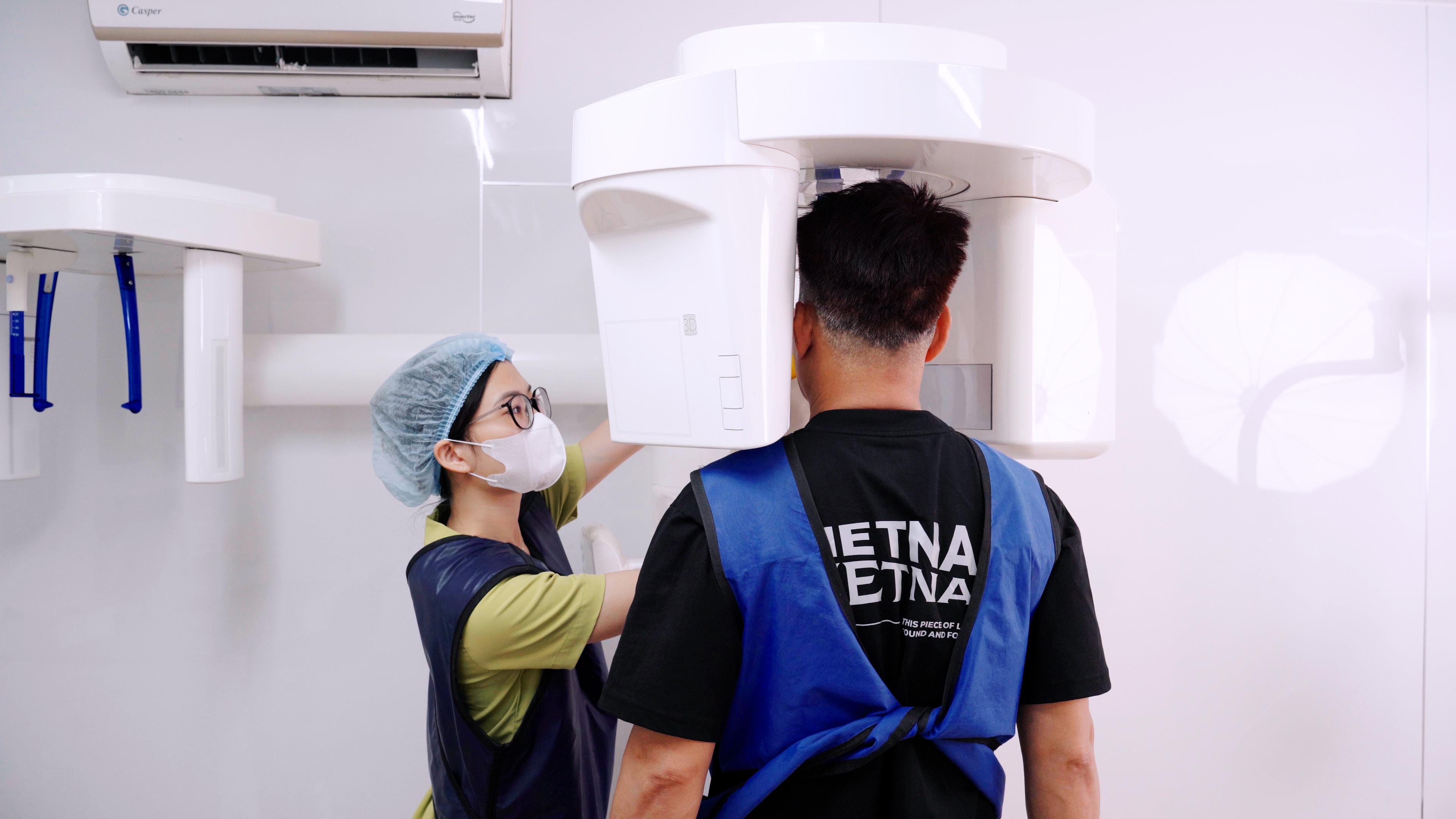
Standard at the major international clinics: CBCT (cone beam CT) for implant planning and complex diagnostics, digital intraoral scanners eliminating the need for physical impressions, CAD/CAM in-house crown fabrication enabling same-day or next-day crowns, and laser dentistry for soft tissue procedures. Implant systems used — Straumann, Nobel Biocare, Osstem — are the same brands used in top clinics globally.
For retirees who left their home country systems some years ago and experienced the older generation of dental technology, this is worth knowing. The Hanoi experience is not a step down.
Emergency Dental Care as a Resident
One of the underappreciated advantages of building a long-term relationship with a Hanoi clinic is emergency access. For established patients at the major clinics, same-day or next-day emergency appointments for acute pain, abscesses, or broken teeth are standard. This compares favourably with the weeks-long waits common in public dental systems in Australia, the UK, and Canada.
For dental emergencies that arise during travel outside Vietnam, knowing your Hanoi clinic can be reached by message or email for advice — and that they hold your records — provides meaningful reassurance.
Practical Tips for Settling In
- Book an introductory check-up early after arriving in Hanoi, before you need treatment. This establishes you as a patient, gets a baseline set of X-rays on file, and gives you the chance to assess the clinic before you are in pain or under time pressure.
- Discuss your complete dental history at that first appointment. Bring any records you have from home — prior X-rays, notes on implants or crown placements, orthodontic history.
- Ask about the payment process. Most clinics accept cash (USD or VND), credit cards, and increasingly bank transfer. Confirm in advance, particularly for larger treatment amounts.
- Consider dental treatment in the early months. If you have deferred dental work, the period after settling into Hanoi — before you are busy with work, social commitments, or travel — is an efficient time to address it.
Related Reading
- Top 6 Dental Clinics in Hanoi
- Is Dental Work in Vietnam Safe?
- Dental Implants in Hanoi: Complete Guide
- All-on-4 in Hanoi
- Hanoi Dental Prices 2026
- Dental Payment Plans for International Patients
- Dental Tourism in Hanoi: First-Timer’s Guide
Sources
- InterNations Expat Insider Survey, Vietnam expat healthcare satisfaction, 2025
- Cigna Global, International Health Insurance Dental Coverage Guide, 2025
- Vietnam Ministry of Health, Private clinic licensing regulations for foreign-invested medical facilities, 2025
- AXA International, IPMI plan comparison: dental benefit structures for Southeast Asia residents, 2024