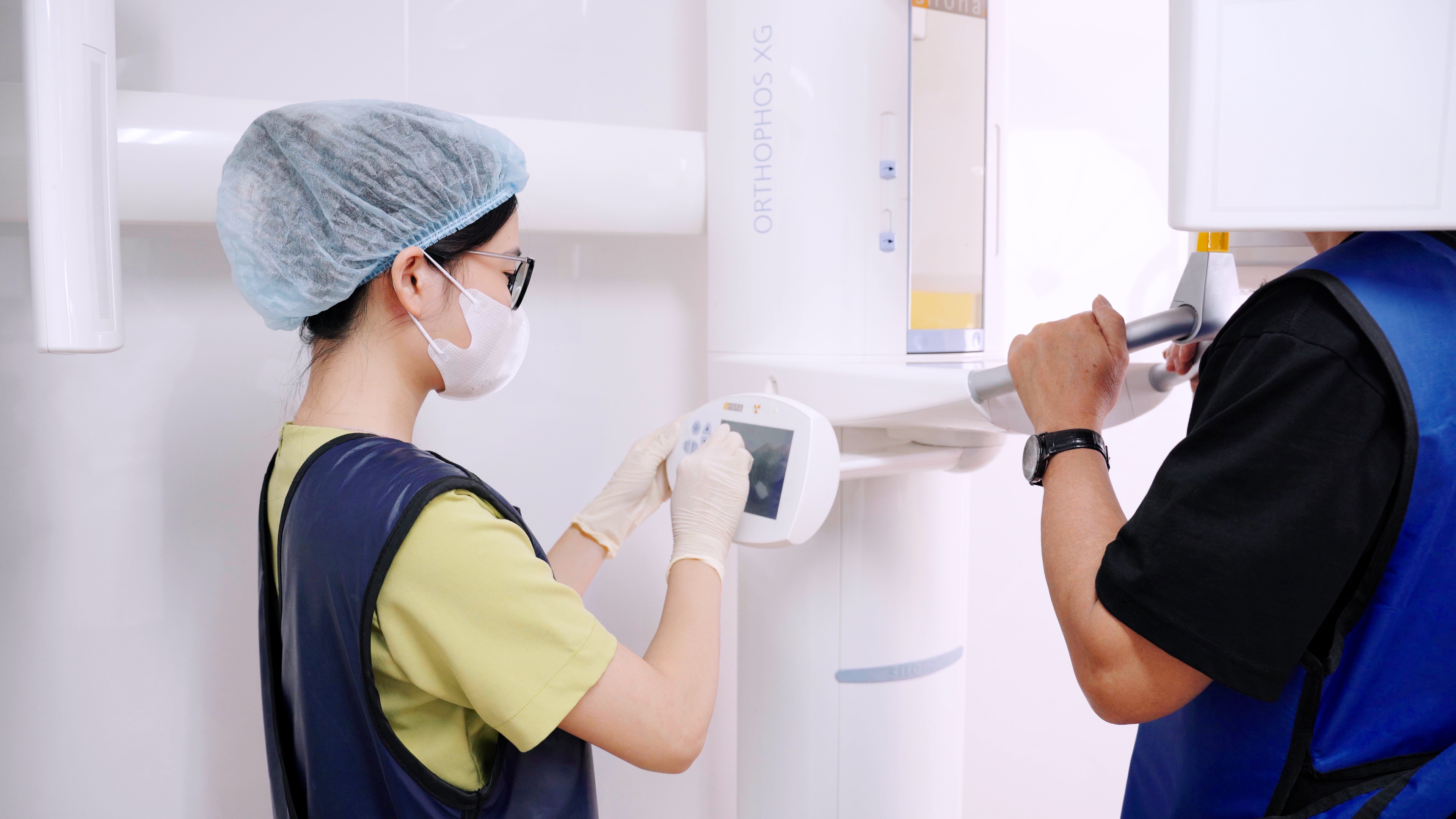
If you are planning dental treatment in Hanoi, especially implants or any surgery, imaging is the first real step after your consultation. Knowing what a CBCT scan is, how safe it is, and what it should cost will help you judge a clinic’s quality and avoid surprises. This guide explains digital X-rays and 3D CBCT imaging in plain terms, with 2026 Hanoi prices.
What Dental X-Rays and CBCT Scans Actually Are
Dental imaging falls into two broad categories, and understanding the difference matters when you compare clinics.
Digital X-rays (2D)
A digital X-ray is the modern replacement for old film X-rays. A small electronic sensor captures the image, which appears instantly on a screen. Common types include the periapical (a single tooth and its root), the bitewing (used to spot decay between teeth), and the panoramic or OPG (a wide single image of the full upper and lower jaw). These flat 2D images are excellent for checking decay, existing fillings, root infections and general bone levels.
CBCT scans (3D)
CBCT stands for cone beam computed tomography. Instead of a flat picture, the machine rotates around your head and builds a detailed three-dimensional model of your teeth, jawbone, nerves, sinuses and airways. Because it shows depth and density, the dentist can measure exactly how much bone is available and where critical structures sit. This is the difference between guessing and planning.
Why CBCT Matters for Your Treatment
A 2D X-ray flattens everything into one plane. A CBCT scan shows the full picture, which changes outcomes for several treatments:
- Dental implants — measures bone height, width and density to place each implant safely and at the correct angle.
- All-on-4 — essential for mapping the whole arch, locating the sinus and nerve, and designing a full-arch restoration.
- Complex extractions — reveals the position of impacted wisdom teeth relative to the nerve before surgery.
- Root canal — finds hidden or curved canals that a flat X-ray misses.
In short, for any surgical or implant work, a CBCT scan is not an upsell. It is the standard of care, and a clinic that places implants without one should give you pause.
Are Dental X-Rays and CBCT Safe?
This is the most common concern, and the reassuring answer is yes. Modern dental imaging uses very low radiation doses.
Digital sensors capture an image with a fraction of the radiation that old film required. A single dental CBCT scan delivers a low dose, broadly comparable to a few days to a couple of weeks of ordinary background radiation from the environment, and dramatically less than a hospital body CT scan. Dentists also follow the ALARA principle — “As Low As Reasonably Achievable” — meaning they only image when it genuinely informs your diagnosis or treatment.
Reputable Hanoi clinics use lead aprons or thyroid collars where appropriate and limit the scan area to the region being treated. If you are pregnant or think you might be, tell the clinic before any imaging.
What X-Rays and CBCT Scans Cost in Hanoi (2026)
Hanoi imaging prices are a fraction of Western costs, and many clinics fold the scan into a treatment plan at no extra charge. All prices are in USD at roughly 25,500 VND to 1 USD.
| Imaging type | Hanoi | US / UK / Australia | Notes |
|---|---|---|---|
| Single digital X-ray (periapical) | $5-$20 | $25-$150 | Often free with consultation |
| Panoramic X-ray (OPG) | $15-$40 | $100-$250 | Full upper and lower jaw |
| CBCT scan (3D) | $20-$60 | $150-$500 | Often bundled into implant plan |
| CBCT included in implant plan | Often $0 | Rarely free | Common at top Hanoi clinics |
For context, a single implant in Hanoi runs $500-$1,500 and All-on-4 is $4,500-$9,000 per arch, so imaging is a minor line on any treatment plan. When you request a quote, confirm whether the CBCT scan is included; at leading clinics it usually is.
Which Hanoi Clinics Have In-House Imaging
In-house imaging means the clinic scans, diagnoses and plans in a single visit, with no referral to an external radiology centre. That saves time on a short trip and keeps your data with the team treating you.
- Picasso Dental (Old Quarter & West Lake) — top-rated (5.0/4.9) with in-house CBCT and digital imaging, strong for implant and cosmetic planning.
- Westcoast International Dental (4.7, multilingual) — in-house 3D imaging with English and other language support.
- Australian Dental Clinic (4.8) — in-house CBCT and digital X-ray with Australian-trained standards.
- Minh Thu Dental (4.8) and Greenfield Dental (4.7, ortho/Invisalign) — well-equipped general and orthodontic clinics; confirm CBCT availability directly when implants are involved.
When you enquire, ask two questions: does the clinic have an in-house CBCT scanner, and will you receive your scan files to take home?
Getting Your Scan Records to Take Home
Always ask for your CBCT and X-ray files before you leave Hanoi. Most clinics provide them on a USB drive or as a download in standard DICOM format, which any dentist worldwide can open. Keeping your own copy lets you get a second opinion, continue follow-up care at home, and hold a complete record of your treatment. A clinic that shares your data freely is a clinic confident in its work.
Related Reading
- Dental Implants in Hanoi
- All-on-4 in Hanoi
- Hanoi Dental Prices 2026
- Is Dental Work in Vietnam Safe?
- Top 6 Dental Clinics in Hanoi
Planning implants or All-on-4? Compare verified Hanoi clinics with in-house imaging on SmileJet and get a treatment plan before you travel.
Sources
- International Atomic Energy Agency — guidance on radiation doses in dental and medical imaging
- American Dental Association — recommendations on dental radiograph use and the ALARA principle, 2025
- European Academy of DentoMaxilloFacial Radiology — clinical guidelines on cone beam CT use
- World Health Organization — communicating radiation risks in paediatric and adult imaging