You have probably seen the threads: a botched smile, an implant that failed within a year, a quote that doubled mid-treatment. Dental tourism horror stories are real, and they are worth taking seriously. But almost every one follows a predictable pattern, and those patterns are avoidable.
This guide breaks down the failure modes that actually cause problems, with no invented victims or scare statistics, and ends with a prevention checklist you can use before booking anything.
The Cheapest-Clinic Trap
This is the single most common root cause. Patients compare clinics on price alone, pick the lowest number, and discover too late that the number was low for a reason.
The economics make the trap obvious once you see them. A genuine, branded implant fixture has a real cost. In Hanoi, a single implant runs $500-1,500: roughly $500-900 for Osstem (South Korea), $900-1,400 for Nobel Biocare, and $1,000-1,500 for Straumann. A clinic quoting $250-300 for a complete implant cannot fit a branded fixture, a CBCT scan, an abutment, a crown, and a warranty inside that number. Something is being substituted, usually a counterfeit or unbranded fixture with no clinical track record.
The fix is not to assume cheap equals bad across a whole country. Quality Hanoi clinics are already 60-85% cheaper than the US, UK, or Australia because of lower operating costs, not lower standards. The trap is the outlier that undercuts even the affordable clinics.
| What you are quoted (single implant) | What it usually means |
|---|---|
| $500-1,500 | Realistic range for a branded fixture and crown |
| $300-450 | Question the brand, imaging, and warranty closely |
| Under $300 | Almost certainly missing the fixture brand, a CBCT scan, or a warranty |
No Warranty, No Recourse
The second pattern is treatment with no written guarantee. Everything looks fine when you fly home. Six months later a crown chips or an implant feels loose, and you have nothing in writing to fall back on.
Reputable clinics back their work with written warranties, typically 5-10 years on implants and 3-5 years on crowns and bridges. A verbal “don’t worry, we stand behind it” is worthless once you are in another country. If the warranty is not on paper with the clinic’s contact details and clear terms, treat it as if it does not exist.
No Records to Take Home
Closely linked to the warranty problem: patients leave without the documentation that any future dentist needs. If an issue surfaces back home and your local dentist has no CBCT scan, no treatment notes, and no idea which implant system was used, they are diagnosing blind, and warranty claims become almost impossible.
Before you leave, you should have your CBCT scan and X-rays, an itemised treatment plan, the implant or crown brand and batch certificate, and the written warranty. Reputable clinics provide all of this as standard.
Rushing a Multi-Procedure Trip
The third major pattern is biology versus the calendar. Patients try to compress implants, crowns, and extractions into one short holiday because the flights are booked and the hotel is paid for.
Implants do not work that way. A standard implant needs an osseointegration period of roughly 3-6 months between placement and the final crown, which realistically means two trips. All-on-4 (from $4,500-9,000 per arch, with All-on-6 typically higher) can sometimes carry a temporary bridge within days, but the permanent prosthesis still comes on a later visit. Cramming everything into one rushed week forces shortcuts that drive failures. Plan the trip around the treatment timeline, not the other way around. For a realistic schedule, see our guide on how long to stay for dental implants.
Skipping the Diagnostics
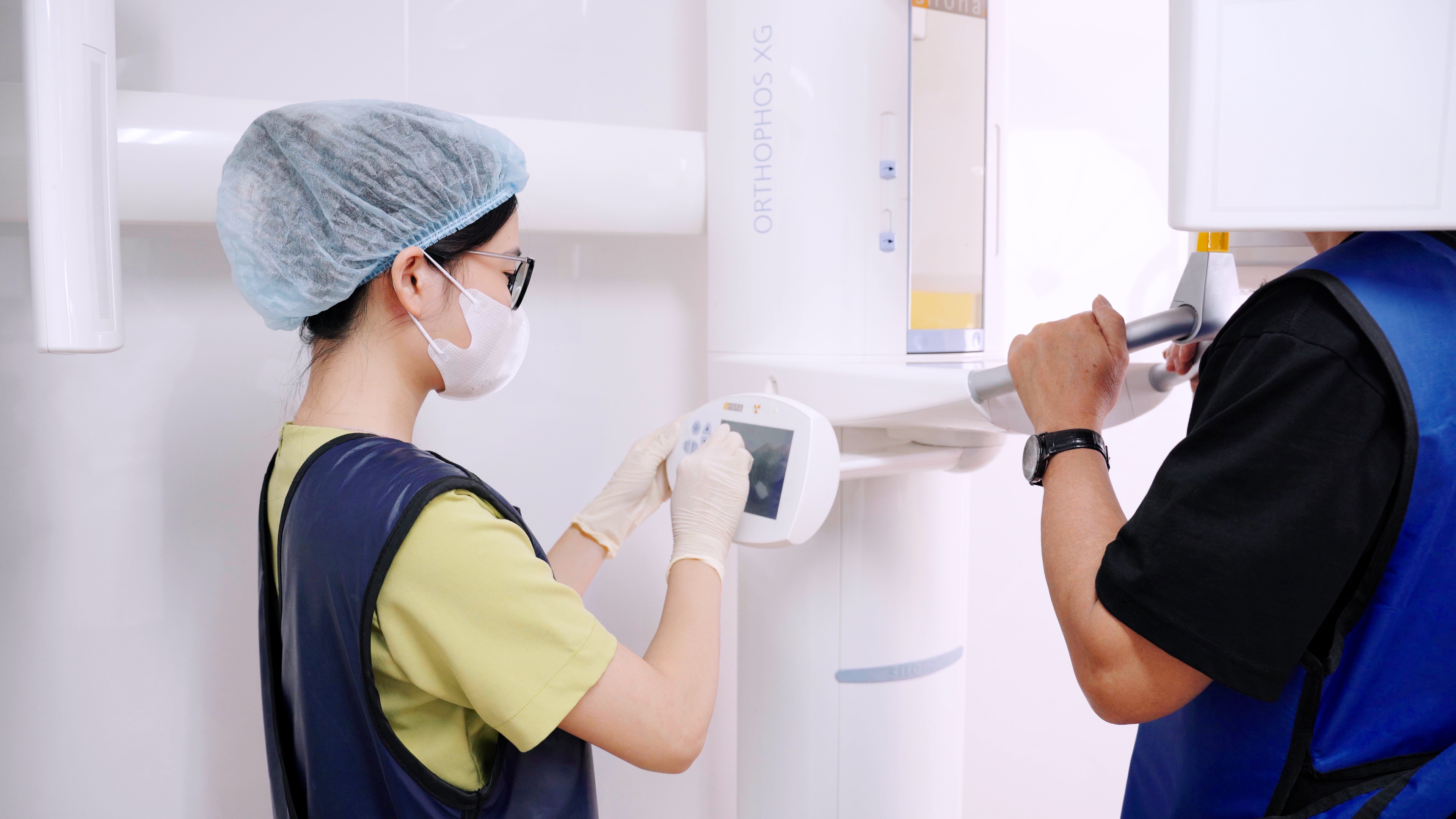
A quieter failure mode: placing implants without a CBCT scan. The scan maps bone volume and nerve position, and skipping it is how implants end up too close to a nerve or in insufficient bone. If a clinic offers to place implants with only a 2D X-ray, walk away. This single rule prevents a large share of serious complications, and top Hanoi clinics treat the CBCT as non-negotiable, which is part of why they reach 95-98% success rates.
The Prevention Checklist
Run through this before you commit to any clinic, anywhere:
- Get a diagnosis at home first so you know what you actually need and can spot upselling.
- Collect three itemised quotes and treat any dramatic outlier as a warning, not a win.
- Confirm the implant brand in writing (Osstem, Nobel Biocare, Straumann, Dentium, Neodent) and ask for the certificate.
- Insist on a CBCT scan before any implant placement.
- Get the warranty in writing with terms and the clinic’s contact details.
- Confirm the named dentist performing your procedure and their credentials.
- Plan the timeline around the biology, accepting two trips for full implants.
- Take every record home: scans, treatment notes, brand certificates, warranty.
- Use a verified marketplace like SmileJet to shortlist clinics with documented warranties and credentials.
In Hanoi, clinics that meet this bar include Picasso Dental (Old Quarter and West Lake), Westcoast International Dental, Australian Dental Clinic, Minh Thu Dental, and Greenfield Dental. Choosing from a vetted shortlist is what turns dental tourism from a gamble into a planned, lower-cost version of care you would get anywhere.
The Bottom Line
Dental tourism horror stories are real, but they are not random. They come from the cheapest-clinic trap, missing warranties, missing records, and rushed timelines, and every one of those is a decision you control. Avoid those four mistakes and run the checklist, and you put yourself in the 95-98% who get exactly what they came for: quality dental work at a fraction of the price back home.
Find verified Hanoi dental clinics on SmileJet
Related Reading
- Is Dental Work in Vietnam Safe?
- Hanoi Dental Prices 2026
- How Long Should You Stay for Dental Implants?
- Top 6 Dental Clinics in Hanoi
- Dental Implant Savings in Vietnam
Sources
- WHO Oral Health Fact Sheet — global standards for safe oral health care delivery
- FDI World Dental Federation — international standards on infection control and patient safety
- International Journal of Oral & Maxillofacial Implants — peer-reviewed evidence on implant success and failure rates
- Medical Tourism Association — patient guidance and clinic evaluation frameworks for treatment abroad