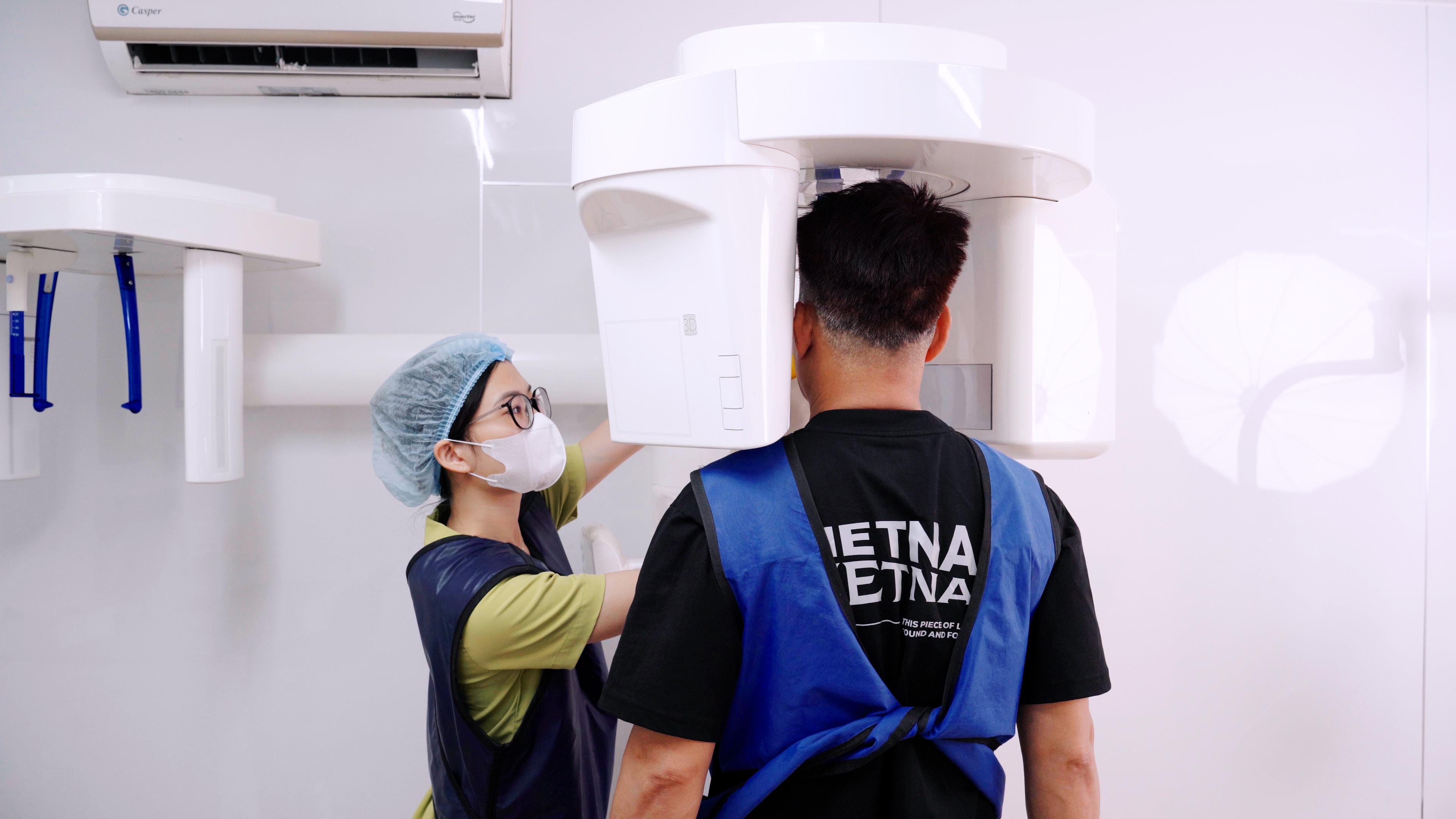
Veneers are among the most commonly requested treatments at Hanoi dental clinics, and the composite-vs-porcelain question comes up in almost every veneer consultation. Both types are available in Hanoi at a fraction of Western prices, but the choice has real long-term consequences for your smile, your schedule, and your wallet. This guide gives you an honest, clinical comparison so you can make the right call before you book.
The Core Difference
The distinction between composite and porcelain veneers comes down to where and how the veneer is made.
Composite veneers are sculpted directly onto your tooth surface by the dentist — no laboratory, no waiting, done in a single appointment. The material is a tooth-coloured resin compound that bonds directly to enamel and is shaped, layered, and polished chairside. The entire process sits in the dentist’s hands; the outcome depends heavily on the clinician’s artistry and experience.
Porcelain veneers — the most common type in Hanoi is E.max lithium disilicate ceramic — are precision-fabricated by a dental laboratory from impressions or a digital scan of your teeth. The lab mills or press-fires each veneer to an exact specification, then the dentist bonds them in a second appointment after the laboratory work is complete, typically 3–7 days later.
Neither is inherently better in all situations. The right choice depends on your timeline, your budget, how many teeth you are treating, and what you want the end result to look like in ten years.
Price Comparison in Hanoi
The cost gap between Hanoi and Western countries is substantial for both material types. The table below gives a realistic range based on current 2026 clinic pricing.
| Type | Price per tooth (Hanoi) | Price per tooth (Australia / UK / US) | Appointments | Lifespan |
|---|---|---|---|---|
| Composite veneers | $80–$200 | $400–$1,200 | 1 (same-day) | 3–7 years |
| E.max porcelain veneers | $150–$400 | $1,200–$2,500 | 2 (5–7 days) | 10–15 years |
| Zirconia veneers (ultra-thin) | $200–$450 | $1,500–$3,000 | 2 (5–7 days) | 15–20 years |
Even at the top end of Hanoi pricing, a full set of 8 E.max porcelain veneers costs $3,200 — less than the price of a single veneer at many Australian or American practices. The savings on a full smile makeover routinely exceed $15,000–$20,000, which is why dental tourism to Hanoi for cosmetic work continues to grow year on year.
Composite Veneers: Detailed Pros and Cons
Advantages of Composite
Same-day results. Composite veneers are completed in one appointment — typically 2–4 hours depending on how many teeth you are treating. You walk in with your natural teeth and walk out with your new smile. For patients on a short trip who cannot afford multiple visits, this is the decisive factor.
Lower cost. At $80–$200 per tooth, composite is meaningfully cheaper than E.max for most patients. An 8-veneer composite smile runs $640–$1,600 in Hanoi versus $1,200–$3,200 for E.max — a difference that is significant even on a dental tourism budget.
Reversibility. Because composite bonds to enamel without requiring the same degree of tooth reduction as porcelain, it is considered a more reversible treatment in straightforward cases. If you change your mind about the shape or shade, the composite can be removed without permanently altering your natural tooth structure. This makes composite a lower-stakes entry point into cosmetic dentistry.
Repairability. A chip or crack in a composite veneer can usually be repaired chairside in a single short appointment without replacing the whole veneer. A cracked porcelain veneer almost always requires a full laboratory replacement.
No temporaries. Because there is no laboratory stage, you do not need to wear temporary veneers between appointments. You leave with the finished result.
Disadvantages of Composite
Shorter lifespan. Composite veneers typically last 3–7 years with proper care, compared to 10–15 years for porcelain. Over a 15-year period, you may replace composite veneers twice while porcelain veneers are still in service. The cost calculation over time is less favourable than the upfront price suggests.
Stain susceptibility. Resin composite is more porous than glazed ceramic. Coffee, tea, red wine, and tobacco stain composite faster and more permanently than porcelain. Most clinicians recommend professional polishing every 6–12 months to maintain appearance and advise patients to moderate staining foods and beverages.
Less optical depth. High-quality composite work at a skilled Hanoi clinic is excellent and undetectable to most people. However, ceramic transmits light differently to resin — it has a natural translucency and depth that closely mimics tooth enamel. Under close scrutiny or certain lighting, composite does not fully replicate the three-dimensional appearance of a natural tooth the way E.max does.
Technique-dependence. Because composite veneers are created freehand by the dentist, the quality of the result varies more between clinicians than with laboratory-fabricated ceramic. Choosing an experienced clinician with a strong cosmetic portfolio is especially important for composite veneers.
Porcelain E.max Veneers: Detailed Pros and Cons
Advantages of E.max Porcelain
Superior aesthetics. E.max lithium disilicate ceramic is the gold standard for cosmetic veneer material. It transmits light in a way that closely replicates natural enamel, producing a result that looks genuinely tooth-like rather than coated. For smile designs involving 6 or more veneers across the smile zone, the visual consistency and depth of E.max is difficult to match with composite.
Longer lifespan. With proper care, E.max porcelain veneers last 10–15 years. Some studies report survival rates above 90% at 10 years when placed by experienced clinicians on appropriate cases. The higher upfront cost amortises well over the lifespan of the restoration.
Stain resistance. The glazed surface of ceramic does not absorb pigment the way resin does. E.max veneers maintain their colour stability over years of coffee, tea, and wine consumption in a way that composite cannot match.
Consistent, predictable outcome. Laboratory fabrication involves digital design tools, precise milling or press-firing, and quality control before the veneer ever reaches your mouth. The result is highly predictable and consistent across all teeth in the set.
Disadvantages of E.max Porcelain
Requires two visits. The laboratory fabrication gap — typically 3–7 days — is a firm constraint. You cannot get E.max veneers in a single day unless your clinic has an in-house CAD/CAM milling system (CEREC). Most Hanoi clinics use external laboratories, so the two-appointment schedule is the standard pathway.
Irreversible in most cases. Preparation for porcelain veneers involves lightly filing the front surface of the tooth to create space for the ceramic shell. This is a permanent alteration. Once you have had teeth prepared for porcelain veneers, they will always need to be covered — whether by veneers or another restoration.
Higher cost. At $150–$400 per tooth in Hanoi, E.max is more expensive than composite. For patients treating 10–12 teeth, the budget difference is meaningful.
Temporaries required. Between the preparation appointment and the fitting appointment, your prepared teeth are covered with temporary veneers. These are functional but are not the final result — some patients find the waiting period uncomfortable or stressful.
Which Clinics in Hanoi Offer Same-Day Composite Veneers?
Four of the leading Hanoi clinics featured on this site offer chairside composite veneer placement for suitable cases — meaning the whole procedure, from consultation to polished final result, happens in a single visit:
- Picasso Dental Old Quarter — well-regarded for composite artistry with a strong international patient portfolio and detailed before/after case documentation
- Picasso Dental Westlake — the same clinical team and protocols as the Old Quarter branch, with more capacity for complex cases
- Australian Dental Clinic — Australian-standard composite technique in a clinic used to treating patients from Australia, New Zealand, and the UK on short itineraries
- Westcoast International Dental — multilingual team offering both same-day composite and standard 2-appointment E.max programmes
All four clinics also offer E.max porcelain veneers on the standard 2-appointment schedule, along with full smile design consultations to help you decide which material suits your case. Greenfield Dental and Minh Thu Dental are additional options worth consulting if you are comparing quotes across multiple clinics.
How to Decide: A Decision Framework
The material question is straightforward once you know your constraints.
Choose composite veneers if:
- Your trip is 2–3 days and you cannot extend it
- You are new to veneers and want a reversible option to “test drive” the look
- You are treating 1–3 teeth rather than a full smile makeover
- Cost is the primary constraint
- You are comfortable with a shorter lifespan and plan to refresh your veneers in 5–7 years
Choose E.max porcelain veneers if:
- You have 5–7 days in Hanoi and can accommodate two appointments
- You are doing a full smile design involving 6 or more veneers
- You want maximum longevity and the most natural aesthetic outcome
- You drink significant amounts of tea, coffee, or red wine and want stain resistance
- You are prepared for a permanent commitment to the restoration
The hybrid strategy. A practical approach used by some international patients: get composite veneers on a first visit to establish the shape and shade you want, live with the result for a few months, and return for E.max on a subsequent trip once you are confident in the design. The composite acts as a three-dimensional preview. Most Hanoi clinics are experienced with this approach and can replicate the composite design in ceramic.
What About Dental Implants and Other Treatments?
If you are planning a broader cosmetic or restorative trip to Hanoi, veneers are frequently combined with other treatments. Dental implants and All-on-4 procedures are popular additions for patients who also need to address missing teeth before beginning a veneer programme. Veneers are only placed on existing natural teeth or crown restorations — the implant and restorative work comes first. Discuss your full treatment plan with the clinic during the initial consultation so timing and sequencing can be planned correctly.
You can explore the full range of veneer options — including no-prep and ultra-thin ceramic variants — on the veneers treatment page.
Making the Most of Your Hanoi Consultation
Whichever material you lean toward, arrive at your consultation with clear references. Bring photos of smiles you like — shape, shade, and proportions. Ask to see case photos from the specific clinician who will be doing your veneers, not just the clinic’s general portfolio. If you are considering composite, ask how the dentist builds layering and whether they use multiple shades or a single shade per tooth.
For E.max cases, ask which laboratory the clinic works with, whether a digital smile design preview is included, and what happens if you are unhappy with the final shade after bonding. Understanding the clinic’s revision policy before you commit matters.
Related Reading
- Porcelain Veneers in Hanoi — Treatment Guide
- Digital Smile Design Hanoi
- Hanoi Dental Prices 2026
- Top 6 Dental Clinics in Hanoi
- How Long to Stay in Hanoi for Veneers
- Choosing a Dental Clinic in Hanoi: Checklist
- Dental Tourism in Hanoi: First-Timer Guide
Sources
- Journal of Prosthetic Dentistry, Longevity of composite vs ceramic veneers, 2023
- Vietnam Dental Association, Material pricing benchmarks for international patients, 2025
- ITI, Adhesive veneer treatment guidelines, 2024
- International Journal of Esthetic Dentistry, Clinical performance of E.max veneers at 10-year follow-up, 2022