If you have lost most or all of your teeth and have been quoted for both All-on-4 and All-on-6, the obvious question is whether the extra implants are worth the extra money. This guide gives you honest numbers for Hanoi, explains who genuinely benefits from six implants over four, and lays out the timeline and trips involved.
What Is All-on-6?
All-on-6 is a full-arch tooth replacement in which six titanium implants are placed in the jaw to support a single fixed bridge of replacement teeth. Like All-on-4, the bridge is permanent — it does not come out for cleaning, it does not slip, and it restores most of your natural biting force.
The defining difference is the implant count. Where All-on-4 anchors the arch on four implants (two straight at the front, two angled at the rear), All-on-6 adds two more, spreading the load of chewing across additional anchor points.
Cost in Hanoi: $6,000–$11,000 per arch.
That price sits above All-on-4 ($4,500–$9,000 per arch) for a simple reason: two extra implants, two extra abutments, and additional surgical and laboratory work. The implant brand drives much of the spread — an arch built on Osstem implants sits at the lower end, while Nobel Biocare or Straumann systems push toward the top.
All-on-6 vs All-on-4: The Honest Comparison
The marketing tendency is to present “more implants” as automatically better. Clinically, that is not how it works. More implants help in specific situations and add cost in all of them.
| Factor | All-on-4 | All-on-6 |
|---|---|---|
| Implants per arch | 4 | 6 |
| Cost in Hanoi | $4,500–$9,000 per arch | $6,000–$11,000 per arch |
| Bone required | Less; often avoids grafting | More; sufficient volume in six sites |
| Bite-force distribution | Good | More even across the arch |
| Best suited to | Most patients; lower jaw | Large jaws, strong bites, upper arch |
| If one implant fails | Bridge support more affected | More redundancy in support |
| Surgery complexity | Lower | Slightly higher |
The redundancy point is real but easy to overstate. With genuine implants and a competent surgeon, failure rates are low either way — under 3% globally, and 95–98% success at top Hanoi clinics. The extra two implants are an insurance margin, not a cure for poor planning.
Who Actually Needs All-on-6?
All-on-6 tends to be the better recommendation when:
- You are restoring the upper jaw. Upper-jaw bone is softer and less dense than the lower jaw, so spreading load across six implants can improve stability.
- You have a large or heavily muscled jaw and generate strong bite forces — common in patients who grind or clench.
- You have ample bone volume in all six implant positions, so the extra implants can be placed without grafting.
- You want maximum long-term redundancy and the higher cost is not a barrier.
All-on-4 is usually the right call when bone is limited, when the lower jaw is being treated, or when you want a clinically sound result at the lower price. Honestly: for a large share of patients, All-on-4 delivers the same day-to-day function, and paying for All-on-6 buys engineering margin you may never need. A good dentist will tell you which camp you fall into after a CBCT scan — and will not upsell you to six implants your jaw does not require.
For a deeper look at the four-implant option, see the All-on-4 treatment guide.
The Process and Timeline
The clinical pathway for All-on-6 mirrors All-on-4, with two more implant sites:
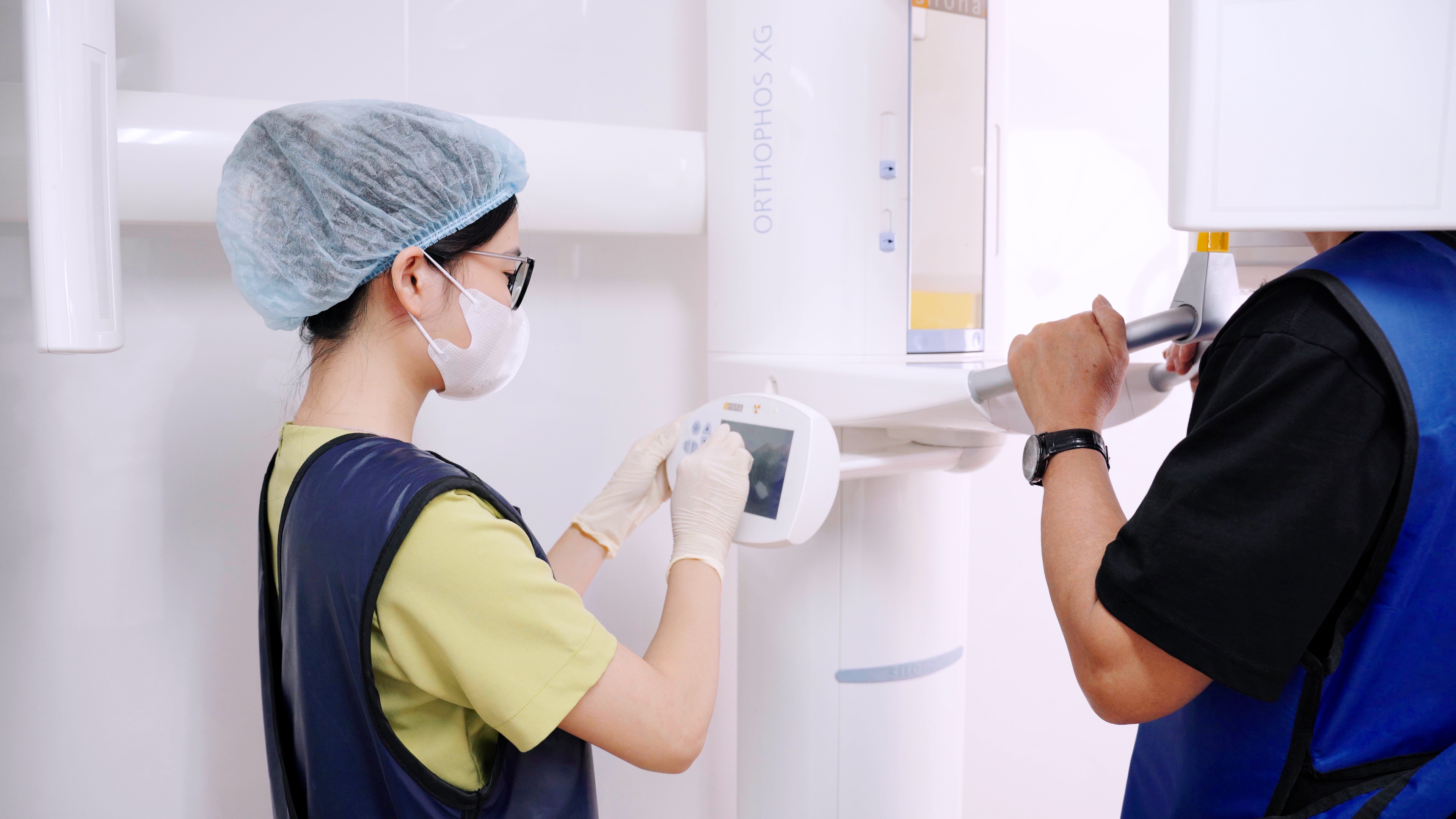
- Consultation and CBCT scan. A cone-beam CT scan maps bone volume and density and confirms whether six implants can be placed. This is non-negotiable and standard at reputable Hanoi clinics.
- Surgery. Any remaining teeth are extracted, six implants are placed under local anaesthetic (sedation is available), and a fixed temporary bridge is often fitted the same day or within a few days.
- Healing and osseointegration. The implants fuse with the bone over three to six months. You wear the temporary bridge during this period and eat a modified diet.
- Permanent prosthesis. Once integration is confirmed, the final bridge — acrylic, composite, or zirconia depending on budget — is fabricated and fitted.
How Many Trips to Hanoi?
Most international patients make two trips, roughly three to six months apart: one for surgery and the temporary bridge, one for the permanent arch. The first trip usually needs about 5–7 days to allow for healing checks; the second is shorter, often 3–5 days.
If two long-haul trips are impractical, ask whether the clinic offers a same-day fixed temporary protocol and a compressed final-fitting schedule. For a detailed breakdown of stay lengths, read how long to stay in Hanoi for dental implants.
When Hanoi Is — and Isn’t — Worth It
The cost case is strong. All-on-6 at $6,000–$11,000 per arch in Hanoi compares with $28,000–$50,000 per arch in the US, UK, or Australia. Even after flights and a week or two of accommodation, the saving on a single arch typically runs into five figures, and Hanoi clinics are broadly 60–85% cheaper than home-country pricing.
But cheap is not the goal — value is. Hanoi is not the right choice if:
- You cannot commit to the follow-up trip or to remote aftercare coordination.
- You are unwilling to vet clinics and verify they use genuine, traceable implant components rather than unbranded substitutes.
- Your case is medically complex (uncontrolled diabetes, certain bone conditions, heavy smoking) and you have not had it properly assessed.
A rock-bottom quote that omits the CBCT scan, uses unverifiable implants, or promises a permanent arch in days should be treated with caution, not enthusiasm. The clinics worth your trust will happily document their implant brands, show case histories, and set realistic timelines. To gauge overall safety standards, read is dental work in Vietnam safe.
Hanoi clinics with documented full-arch implant experience include Picasso Dental – Old Quarter, Australian Dental Clinic, Westcoast International Dental, Minh Thu Dental, and Greenfield Dental. When you are ready to compare quotes and verified clinics in one place, SmileJet lets you request treatment plans from accredited Hanoi practices.
Related Reading
- Dental Implants Treatment Guide
- All-on-4 Treatment Guide
- Hanoi Dental Prices 2026
- How Long to Stay in Hanoi for Dental Implants
- Dental Implant Savings in Vietnam
Sources
- International Team for Implantology (ITI) — consensus guidance on full-arch implant-supported prostheses
- American College of Prosthodontists — patient guidance on implant-supported full-arch restorations
- Hanoi Dental Association — annual member survey on full-arch implant pricing (2025)
- Vietnam Medical Tourism Association — patient outcome data for implant procedures at accredited Hanoi clinics (2025)